
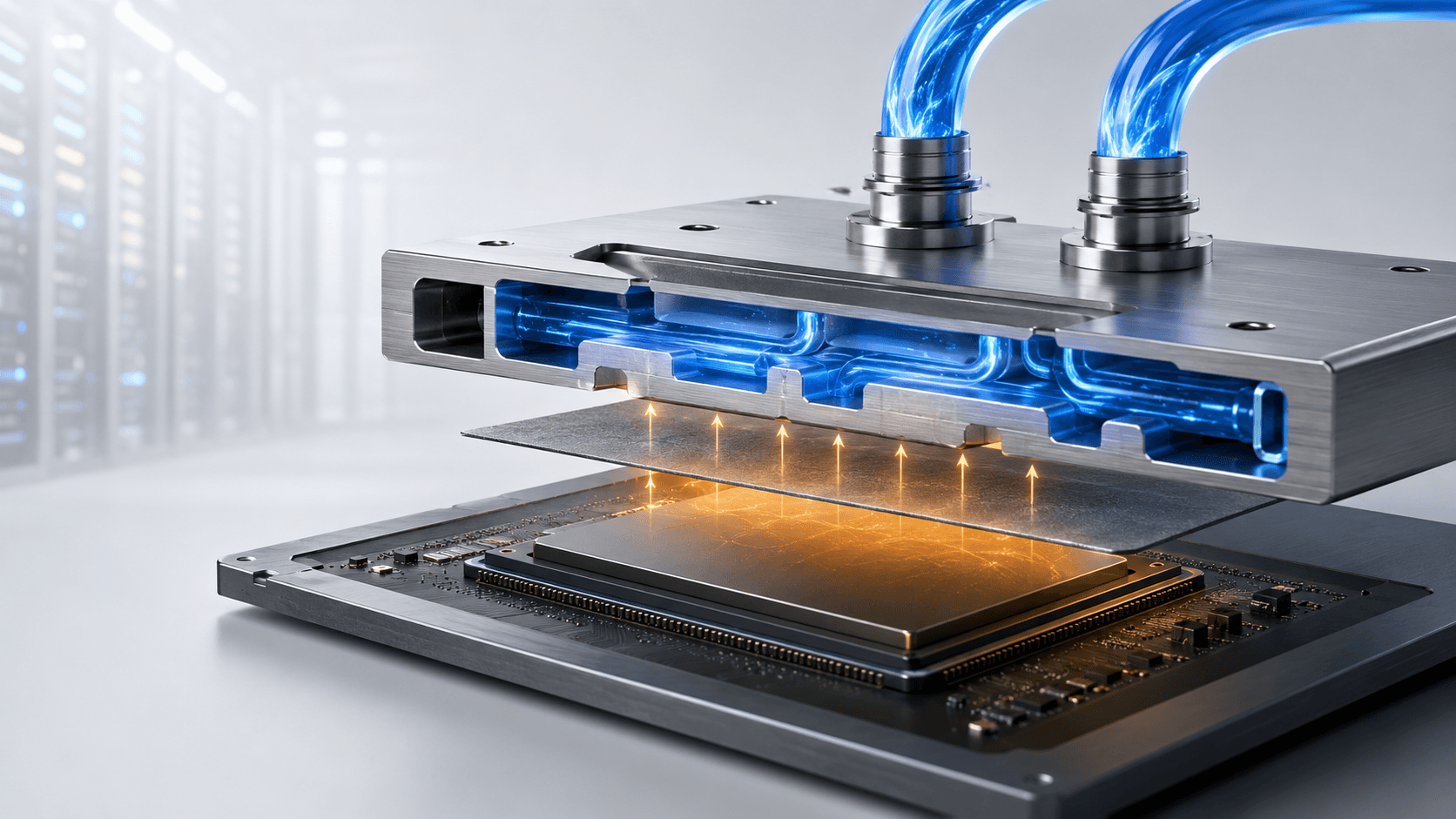
Modern AI processors generate extraordinary amounts of heat in a very small area. Removing that heat efficiently depends not only on the liquid cold plate, but also on a much thinner and easier-to-overlook component between the processor and the cold plate: the thermal interface material.
In server manufacturing, the process often called TIM curing helps that interface reach a stable, repeatable thermal condition before the server proceeds to final performance testing. The name is convenient, although technically not every TIM “cures” through a chemical reaction. Some materials cure, while phase-change materials soften, flow and settle when heated.
Either way, the manufacturing objective is the same: create a consistent thermal path from the heat-generating device into the cooling system.
What is a thermal interface material?
Even highly polished surfaces are not perfectly flat. At a microscopic level, the top of a processor and the mating surface of a cold plate contain small peaks and valleys. If the two surfaces are placed together without an interface material, microscopic air gaps remain between them.
Those gaps matter because air conducts heat poorly compared with the materials used in a properly assembled thermal interface. A TIM fills these surface irregularities and reduces the thermal resistance between the processor package and the cold plate.
Common TIM formats include thermal grease, gels, pads, adhesives and phase-change materials. The appropriate material depends on factors such as heat flux, assembly pressure, serviceability, expected operating temperature and product life.
What happens during TIM curing or thermal conditioning?
During controlled thermal conditioning, heat is introduced into the cooling loop or assembly so the interface reaches its intended temperature range. Depending on the TIM chemistry, the material may soften, change phase, spread across the contact area or complete a curing reaction.
For a phase-change material, heating allows the material to conform more closely to the mating surfaces. Under the clamping force of the assembled cold plate, it can fill microscopic gaps and establish a thinner, more uniform bond line. After the material cools, the interface should remain properly seated.
The goal is not simply to make the assembly hot. The process must provide sufficient and uniform thermal exposure without exceeding the limits of the processor, seals, hoses, connectors or other nearby components.
Why does the process matter in AI servers?
As processor power and heat flux increase, small inconsistencies at the thermal interface become more important. A poorly conditioned interface can create localized thermal resistance, causing one area of the device to run hotter than expected even when coolant temperature and flow appear normal.
This can lead to:
- Higher or uneven processor temperatures
- Reduced thermal margin
- Inconsistent results between otherwise identical servers
- Premature throttling during functional testing
- False failures that appear to be cooling-system problems
- Rework that is difficult to diagnose later in the production line
The issue is especially important in mass production. A single server may appear acceptable, but an uncontrolled process can create variation across hundreds or thousands of assemblies. Manufacturing quality therefore depends on repeatability, not merely on reaching a temperature once.
What should manufacturers control?
A robust process typically considers several variables together:
- Temperature stability. The system should reach and maintain the required thermal condition without excessive overshoot or cycling.
- Exposure time. Timing should begin when the relevant part of the assembly reaches its target condition—not simply when the heater is switched on.
- Coolant flow and pressure. Stable circulation helps deliver uniform heating while keeping the cold plate and loop within their approved operating limits.
- Assembly pressure. The cold plate must maintain the intended mechanical contact with the processor while the TIM settles or cures.
- Process traceability. Recording temperature, time, flow and other relevant data helps demonstrate that each assembly completed the required process window.
The exact limits depend on the selected TIM, hardware design and manufacturer qualification. They should come from validated engineering requirements rather than from a universal recipe.
How is the result evaluated?
TIM quality is usually evaluated through process data and downstream thermal behavior rather than by visually inspecting the completed interface. Engineers may review temperature stability during conditioning, compare device temperatures during functional testing, measure thermal resistance or examine variation across a production sample.
A stable process should produce repeatable thermal performance. If two nominally identical assemblies show materially different temperatures under the same load and coolant conditions, the interface, mounting condition and conditioning history are reasonable places to investigate.
A small layer with a large effect
The thermal interface may be one of the thinnest layers in an AI server, but it sits directly in the path that heat must follow. Controlled TIM curing or thermal conditioning helps turn a mechanically assembled cold plate into a consistent thermal connection.
For manufacturers, the real value is not simply lower temperature. It is a repeatable, traceable process that reduces variation before the server reaches final functional testing.
Long Victory develops thermal-conditioning and heat-exchange measurement equipment for liquid-cooled server manufacturing. These systems are designed to help manufacturers control and document this production stage while adapting the process to their validated product requirements.